ABSTRACT
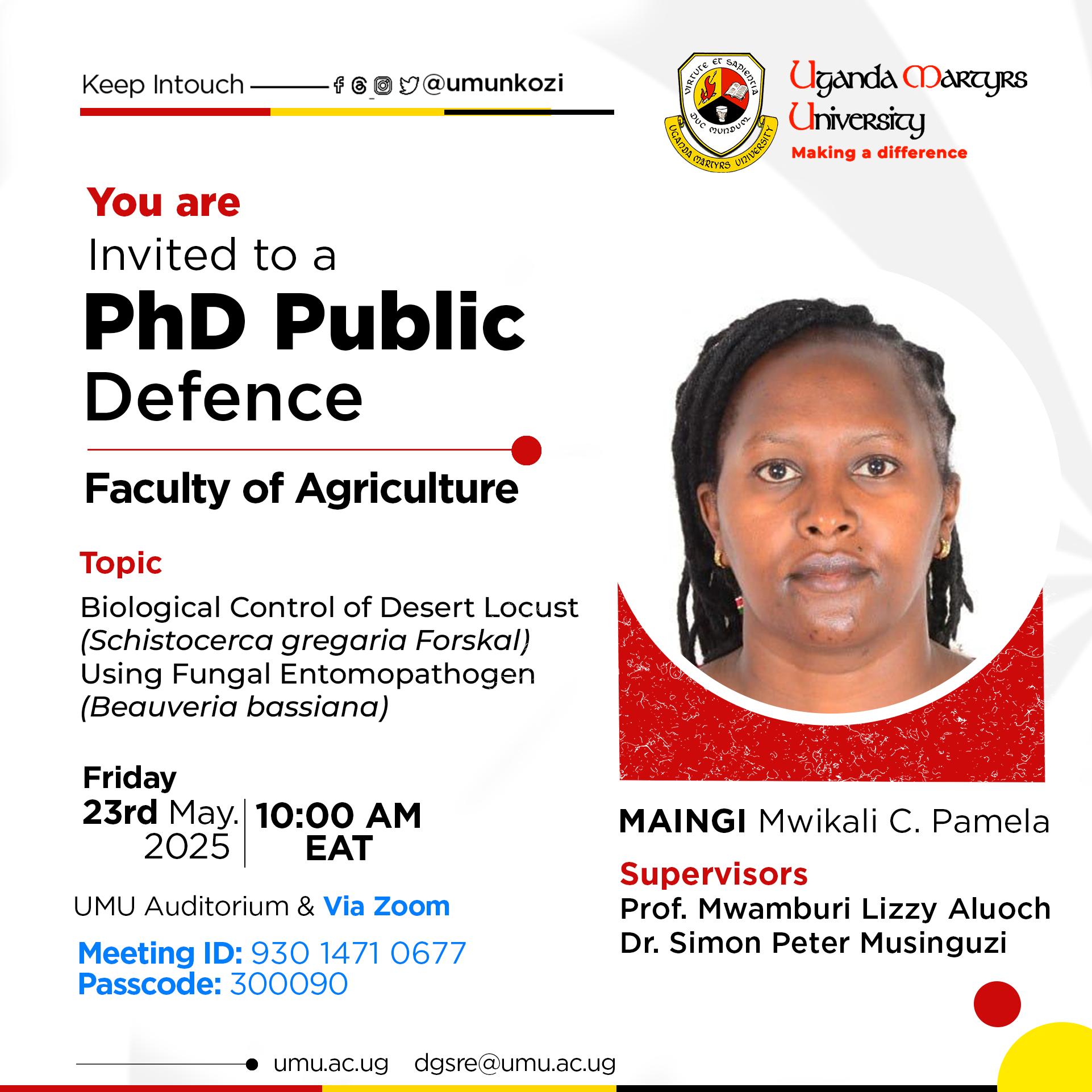
In the recent past, the Horn of Africa witnessed an upsurge in invasion by the desert locust (Schistocerca gregaria). This has witnessed an increased interest in strategies that would ultimately lead to their control. While control of the desert locust has relied on a battery of persistent synthetic insecticides, the side effects, bioaccumulation, environmental persistence and costs has necessitated search of alternative control methods. The biological control, through administration of entomopathogenic microorganisms has gained more attention in recent past. So, biological pest management is best suited as an alternative to synthetic insecticide using natural microorganisms like fungi potentially known as entomopathogens. Therefore, the objective of this study was to evaluate the efficacy of biological control of the desert locust (Schistocerca gregaria) using soil extracted fungal entomopathogen Beauveria bassiana. Specifically, the study aimed at assessing the commonly used methods of management of desert locust in two agro-ecological zones of Laikipia and Isiolo Counties in Kenya; characterizing the entomopathogen (B. bassiana) from two agro-ecological zones; comparing the efficacy of different formulations of the B. bassiana entomopathogen against desert locust; and evaluating the effects of temperature and humidity on spore germination, conidial formation and vegetative growth of B. bassiana. The physical/mechanical control strategies used by the farmers during outbreaks were digging up eggs, handpicking, smoke and baiting. Cultural desert locust control strategies used by the farmers were beating drums, metal beating while in some region motorbike hooting. The rating for preventive strategies, physical/mechanical control methods and cultural method in the control of large swarms of desert locust was low. Traditional methods of locust control should not be solely relied on in management of desert locust outbreak. The study shows the morphological, cultural, and bio-insecticidal variation of entomopathogenic Beauveria bassiana isolated from soil samples in Northern Kenya. While 125 soils samples were analyzed and showed upto 24 isolates, only 7 isolates were confirmed based on colony colour, colony shape and elevation, indicating that the soils in the region have low prevalence of B. bassiana. Genetic characterization using rDNA-ITS regions, identified 7 isolates. Isolate 341 had the best growth rate of 2.5 mm/day followed by 231 with 2.32 mm/day and 334 at 2.26 mm/day. Finally, B. bassiana isolate of 341, 231 and 334 exhibited the highest virulence on S. gregaria. The isolates of B. bassiana were efficacious against desert locust where the isolates formulated with liquid parrafin were the most effective in killing adult and nymphal stages of locust. Temperature and humidity significantly influenced conidia formation. The study recommends, adoption of fungal entomopathogen Beauveria bassiana formulated using liquid paraffin and diatomaceous earth. Future studies needed to focus on the evaluation of high virulent isolates against other potential insect pests to assess their vigorous role as a promising biological control agent against different insect pests.