
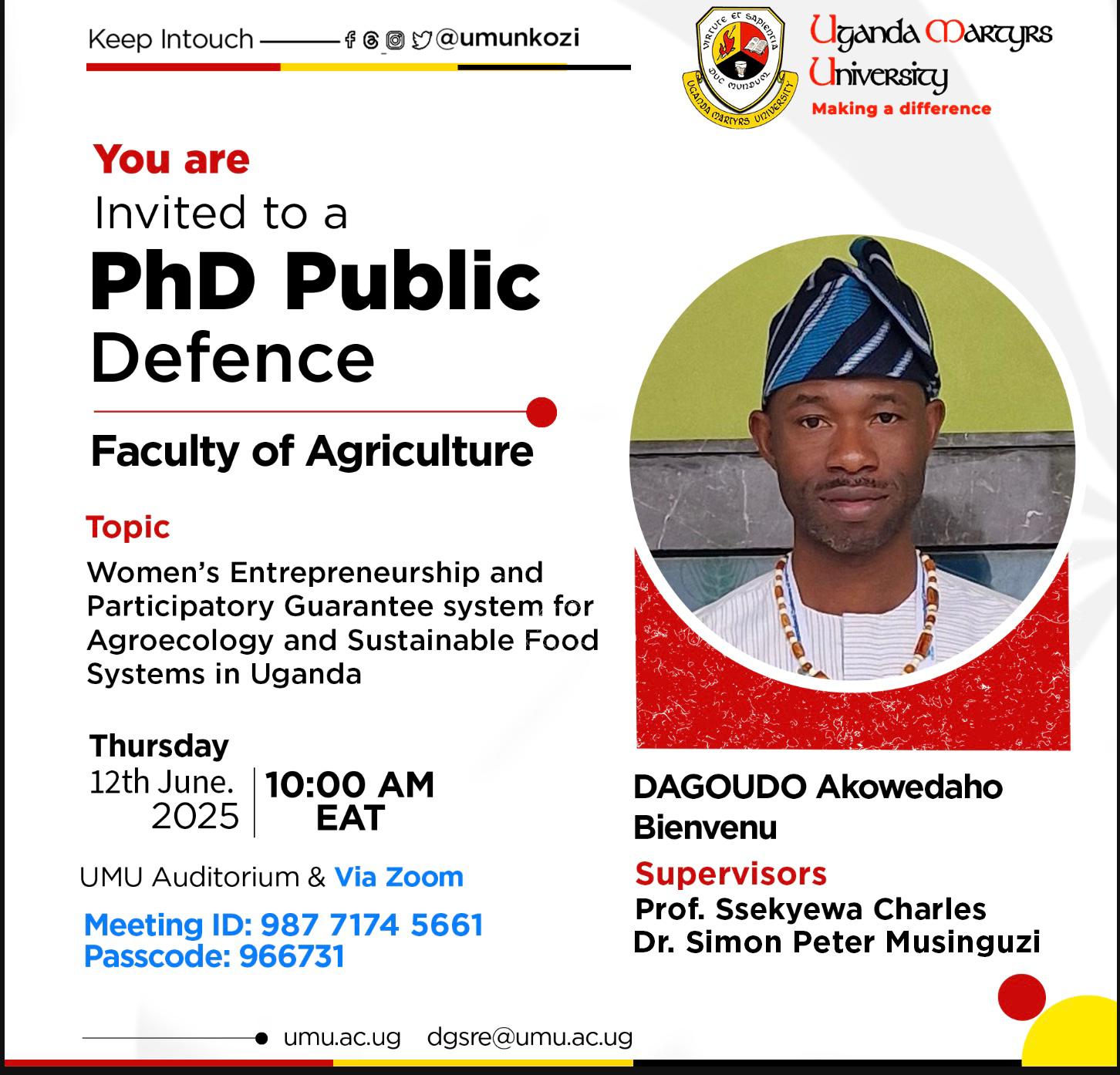
Organic agriculture is viewed nowadays as an opportunity for creating new agri-food systems for agricultural production processing, marketing and consumption based on protecting the environment and supplying nutritious and safe foods to society. From the conceptual framework through the meta-theory of critical realism, the thesis embraces the holistic approach to analysis of women’s entrepreneurship and participatory guarantee system for agroecology and sustainable food systems. The research was realized in Uganda in 7 districts: Wakiso, Masaka, Bukomansimbi, Ssembabule, Kyotera, Kampala and Jinja. The methodology focuses on firstly a multiple-stage stratified sampling to select 310 organic farmers by proportional random sampling in the 8 counties and secondly a total of ten (10) women entrepreneurs, fifteen (15) organic consumers were interviewed at the Organic Farmers Market in Nsambya (Kampala). The findings show that the majority (51.9%) have at least three crops that have been produced in the local climate for a long time, and 58.71% of organic farming has medium integration (animal breeding is mostly based on self-produced animal feed and grazing, and their manure is used for compost and fertilizer). It highlights that seeds and animal genetics for organic farming are in the majority (51.61%) self-produced, neighbor’s farms exchanged, and some specific seeds were purchased at local markets. Half of the cultivated soil is covered with organic residues on 61.61% of organic farms visited. The correlation test revealed that there is a significant positive correlation between diversity animal genetics and crop and livestock integration (r = +0.674, p<0.01), between the harvesting and saving water systems and resilience and adaptability to climate variability (r = +0.546, p<0.01), and between diversity crops and diversity activities and services (r =+ 0.523, p<0.01). The findings highlight that the technical efficiency of organic farming production is 51.60% in Central Uganda. Tobit regression analysis showed that area size, diversity of animal species, agroforestry and silvopastoral systems, recovery capacity from climate shocks or perturbations, and income stability are agroecology factors that influence positively organic farming production technical efficiency. Women entrepreneurs constitute the critical social capital associated with organic farming, guaranteeing resilient markets and preserving the right to food and food sovereignty. The data analysis emphasizes Decision-Making Units from the Data Envelopment Analysis models and Principal Components Analysis (PCA). The finding highlighted that the mean eco-efficiency is 0.492 (±0.14). The eco-efficiency value revealed the challenge of organic farmers to collaborate with women entrepreneurs to create resilient markets. However, the co-creation and sharing of knowledge and culture are the foundation of the business or entrepreneurship in organic farming, which, for achieving agroecology and sustainable food systems, must focus on food tradition as well as human and social values. The Participatory Guarantee System (PGS) ensures alternative certification of organic agriculture through active participation of stakeholders to develop local market (organic farmers’ market in Nsambya) as well as circular and solidarity economy and agroecology business model to guarantee agroecology and sustainable food systems in Uganda. Business ideology proved to be the ideal solution for introducing the new paradigm of entrepreneurial systems thinking to the agricultural sector. Hampered by the stereotype of subsistence and poor activity for organic farming in Uganda, agroecology and sustainable food systems rely on business ideology to highlight the unique opportunity to change mindsets to harness the potential of the agricultural sector to create competitive short chain agribusinesses to reduce poverty and unemployment, limit migration to cities and towns in search of work, and ensure green development.
Join Zoom Meeting
https://zoom.us/j/98771745661?
Meeting ID: 987 7174 5661
Passcode: 966731
